Review of Honey in the Wound by Jiyoung Han
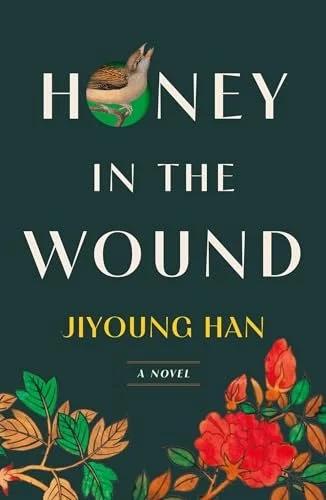
Honey in the Wound by Jiyoung Han (2026). Published by Avid Reader Press / Simon & Schuster.
If you’re new here, and stumbled upon this blog through the mythical powers of the Internet, welcome! I know a lot of visitors to my website are people who randomly come upon this website through search engines like Google, but I also do have a lot of visitors who come back. Regardless: my name is Ashley, and I started this blog in order to keep track of everything I’m coming across in the world.
This blog post is interesting to me because lately, I’ve been struggling to get in my reading time. I was working for the longest time as a freelancer and contractor, but recently pivoted to an 8-5 job where I’m in an office. It’s not hybrid, so I’m always at home trying to put the puzzle pieces together of how I’ll get my reading done. I also continue working on this blog when I’m not at work, so the Instagram reels I’m fed about a 5-9 feel too real right now.
Anyways, I am trying to find that time to read here and there. Somehow I’m still on track for my Goodreads goal, even though I’ve been slowly giving up on the notion of reading goals in life. I think they can be a little too much pressure and takes the fun off of reading at the end of the day, and I want to read because I want to stay in touch with literature while also pursuing my side career as a writer.
I did my master’s thesis in Korean literature and the woman’s history that surrounded the colonial period, and I’ve spent a lot of time on my blog writing and reading about books set during this period. So when I saw a copy of Honey is the Wound in the new fiction section of my library, I grabbed it immediately and checked it out after seeing the synopsis.
In the end I finished this book across two nights. If I had time though, I know I would have read it in one.
Let’s get into the review!
Set across generations, one woman’s story about how she survived the Japanese rule in Korea, and how her Japanese granddaughter rediscovers her history.
The main character and focus of this novel is Young-ja, although we don’t see much of her in the beginning of the novel. It opens in the early 1900s, when her father, Geum-jin, lives with his sister and parents in the woods outside of a farming village. They’re connected with nature and avoid the politics consuming the village involving the Japanese—until it suddenly becomes too late to avoid everything.
When he loses his father and mother in a tragic accident, and his sister runs away to live with the tigers (which the Japanese are also hunting away into extinction), Geum-jin leaves home behind and starts over. He meets his beautiful wife, and has children, including Young-ja, but when his wife becomes involved with stopping the Japanese, it becomes the beginning of the end.
Young-ja is left alone in the world after another tragic incident, and with the help of a rich resistance fighter she finds herself in Manchuria. In Manchuria she starts over again and works in a teahouse, but the influence of the Japanese on her life are impossible to evade, with her ultimately becoming a comfort woman against her will.
The final arc of the novel focuses on her granddaughter, who lives in Tokyo and had no connection to her grandmother until something else major happens. Then her granddaughter slowly unravels what happened to her grandmother and becomes committed to the fight for justice for people like her halmeoni.
Which is an interesting take, as she describes growing up as Zainichi Korean, despite not knowing anything about her mother tongue or where she came from, but the Japanese culture and community she was surrounded by saw her as an outside. Being Korean meant tainted blood and discrimination wherever she went, unfortunately, which is really sad to read about.
All of the novel is also shadowed by the magical realism elements. Each person in the family tends to have their own special ability, with Geum-jin’s sister, for example, leaving his family behind to become one with the tigers in Korea. That manifests through different ways throughout the novel, and can either become a boon or a bane depending on the situations the characters find themselves within.
Overall Thoughts
As I wrote before, I’ve read a lot of novels and work either set in this period, or actually written at the same time it was published. Does that mean I’m an expert? I would never claim such a thing—my life is a series of lessons learning and unlearning what I’ve yet to come across. However, Honey in the Wound adds an interesting element with the magical realism. I thought that was one of the aspects that made it stand out the most.
It also covers a lot of ground in a short amount of time, and it can be quite tragic and dense to read. The Zainichi are always an topic I want to read more about in the long run, and we get more into that kind of story towards the end of the novel—it’s not a Pachinko level overview, but I still found this novel impactful in telling these narratives.
Beyond that though I did think that this novel is good objectively. The writing is gorgeous and we’re immersed in the world of the characters in such an effective way. Maybe it’s because I’m getting worn out on reading these stories, though, that it comes across as the middle of the pack.
I think if Honey in the Wound interests you then you should definitely pick it up! It’s telling important stories, albeit very tragic, and it’s something more people need awareness about.
Follow me below on Instagram, Goodreads, and Letterboxd for more.
![Jeju-do (제주도) is one of those places that reminds you of how stunning the world is
[7.12.2024 부터 7.14.2024 까지]](https://images.squarespace-cdn.com/content/v1/5ea1f794501b7153b29e7cd7/1721033601522-554E76HR01JUHDWZBJ1I/image-asset.jpeg)