If We Cannot Go At the Speed of Light by Kim Cho-yeop
Review of If We Cannot Go At the Speed of Light by Kim Cho-yeop
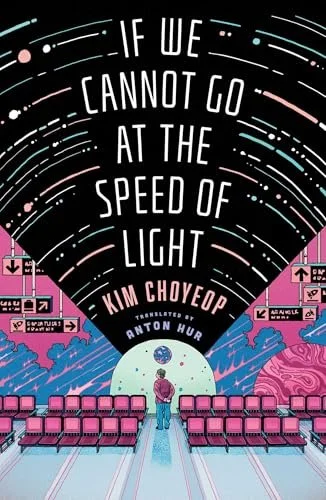
If We Cannot Go at the Speed of Light by Kim Cho-yeop, translated by Anton Hur (2026). Published by S&S/Saga Press.
If you’re new here, and stumbled upon this blog through the mythical powers of the Internet, welcome! I know a lot of visitors to my website are people who randomly come upon this website through search engines like Google, but I also do have a lot of visitors who come back. Regardless: my name is Ashley, and I started this blog in order to keep track of everything I’m coming across in the world.
This blog post is interesting to me because lately, I’ve been struggling to get in my reading time. I was working for the longest time as a freelancer and contractor, but recently pivoted to an 8-5 job where I’m in an office. It’s not hybrid, so I’m always at home trying to put the puzzle pieces together of how I’ll get my reading done. I also continue working on this blog when I’m not at work, so the Instagram reels I’m fed about a 5-9 feel too real right now.
Anyways, I am trying to find that time to read here and there. Somehow I’m still on track for my Goodreads goal, even though I’ve been slowly giving up on the notion of reading goals in life. I think they can be a little too much pressure and takes the fun off of reading at the end of the day, and I want to read because I want to stay in touch with literature while also pursuing my side career as a writer.
I picked up If We Cannot Go At the Speed of Light around the time of its English release because it seemed interesting to me. I didn’t realize at first it was a collection of short stories, but I was fine with that and it was a quick read. I think the hardcover is a little under two hundred pages, which, for me, is a fast read.
Let’s get into the review! Don’t want to ramble too much.
A collection of science fiction short stories that explores not only the extraterrestrial, but alternate realities.
There are only a handful of stories in this collection, but the main thing tying them together is this: the fact that they’re exploring human nature through the lens of science fiction. I learned in my high school writing program that science fiction is one of the best ways to explore humanity, as a confrontation of the unfamiliar forces you to hone in one what really makes people human.
That said, Kim focuses a lot on marginalized people and those on the edges of society. In one story, there’s one about a bus stop in Germany for a nearby elder care facility. A woman waits at a space station in order to see her family, who has settled on another planet, but finds herself in a situation where the intergalactic travel methods have been abandoned once deemed obsolete.
In another story there’s a focus on how we can technically still talk to the dead and communicate with them, with one half of a mother-daughter relationship trying to grasp with the fact the other is dead. While technology is cool and all here, especially when it comes to connecting with the deceased, it creates a tether where one isn’t able to move on from the dead/
One of the stories that stood out the most for me is the one where a girl is narrating the experiences of her grandmother. Her grandmother was on a space expedition and claims to have crashed on a planet where another species found her and took care of her. They did not live long, so when her specific caretaker died, she observed how their custom was to just replace the person.
No one ever believed her about her stories, but her granddaughter was the one who documents the story. We see how her grandmother’s methods change and how she humanizes these creatures in the end.
Another story is about an artist who dreams of another world and creates art around it. She becomes famous artist and everyone assumes she’s made up this random planet, but researchers after her death realize this planet did exist and that she was recreating accurate representations of it.
Overall Thoughts
I’ll have to admit: I actually don’t go for science fiction, as I find that it doesn’t play into my interests as a reader. But if it’s done really well, then I’ll pick it up and continue reading all the way through. This was one of those collections where I wanted to genuinely read all of the stories contained within.
Kim’s work does an excellent job showcasing a wide berth of experiences throughout the collection, and I thought that each of the stories holds its own weight. They also end appropriately in a way where I didn’t think that we needed more, although I see room for some of these becoming novellas or novels.
Hur’s translations are also really good for accessibility. I find that I really enjoy his work as a translator because of how seamless the reading experience is, although I cannot speak for the accuracy. The only work of Korean literature in Korean I’ve picked up lately it a copy of Cursed Bunny I bought in Busan.
I say pick this one up if you get the chance! I enjoyed reading it a lot.
Follow me below on Instagram, Goodreads, and Letterboxd for more.
![Jeju-do (제주도) is one of those places that reminds you of how stunning the world is
[7.12.2024 부터 7.14.2024 까지]](https://images.squarespace-cdn.com/content/v1/5ea1f794501b7153b29e7cd7/1721033601522-554E76HR01JUHDWZBJ1I/image-asset.jpeg)