I'll Love You Forever: Notes from a K-Pop Fan by Giaae Kwon
Review of I'll Love You Forever: Notes from a K-Pop Fan by Giaae Kwon
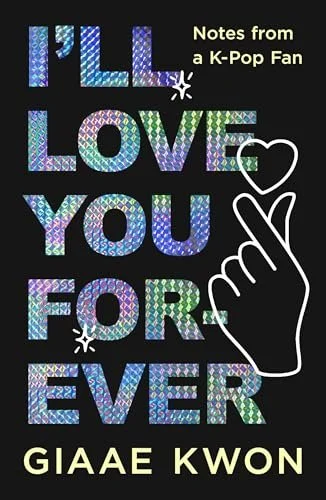
I'll Love You Forever: Notes from a K-Pop Fan by Giaae Kwon (2025). Published by Henry Holt and Co.
If you’re new here, and stumbled upon this blog through the mythical powers of the Internet, welcome! I know a lot of visitors to my website are people who randomly come upon this website through search engines like Google, but I also do have a lot of visitors who come back. Regardless: my name is Ashley, and I started this blog in order to keep track of everything I’m coming across in the world.
I recently fell into a spell of unemployment probably during the worst time to be unemployed, as it was very hard to find a job. I was applying to hundreds of jobs, getting interviews, but no offer was manifesting for me in the near future. So during this time, I had a lot of free time, and spent a good chunk of it chipping away at the blog.
As a book blogger, something I’ve always been super clear about and dedicated towards promoting are local libraries. I know having access to a good library is a privilege, and there are countries where people don’t really have access to books at all. I am so grateful every day that I have access to a decent library system, especially in today’s world.
I’ve been waiting for Giaae Kwon’s I’ll Love You Forever to come out for a long while now. I’ve known about Kwon’s work for a long while now, and on my side Instagram, where I allow myself to not care about the following versus follower ratios, I’ve followed her account for years, so I knew when this book was announced and watched the process of her writing it. I like her account a lot, as it’s very candid, and I enjoy her thoughts on K-pop, the globalization of Korean culture, and everything in-between.
I find it fascinating as someone who isn’t Korean but landed into Korean studies academically. My broader interests are cross-cultural encounters in Korea (so immigration in Korea), but my master’s thesis was on Korean women’s literature and methodologies of resistance. I am in no way an expert in a culture not my own, nor do I pretend to be, so I enjoy seeing Koreans and Korean-Americans, especially women, sharing their thoughts.
So when the release date for this book approached, I put in my request for my copy at the local library. I ended up reading the entire book in one sitting one night, as I was very interested in the essays and what they had to say.
Let’s get into the review before I start rambling too much!
A series of essays on K-pop groups and how they reflect certain periods of the author’s life and coming-of-age.
This book is a series of essays, but the way the essays are split up is quite unique. In advance, something that I thought was really helpful was that Kwon included a bibliography at the end—I really like when nonfiction books do this, as some writers will pass off nonfiction essays as completely original with no research or just not cite in a bibliography. This is the best practice, and I recognized a handful of the titles of on this one.
Anyways, each essay is split into a different subject, but the “title” of each chapter/essay is a different K-pop group. We start the way back from H.O.T., and Kwon does give context for these groups and singers for the stray reader who might not have known what they got themselves into.
While Kwon does chart the rise of K-pop beyond Asia in her essays, she’s also very much charting the rise tides and its fall throughout her own life. She begins with her youth in California, where her family was very much involved in the local Christian community. If you know nothing about the Korean Christian community in California, go look it up. It’s fascinating.
Through her essays she describes her rising love for groups like H.O.T., TVXQ, Girl’s Generation, and ultimately BTS, which is the recent obsession as of the early 2020s, she describes her own upbringing intertwined with the contemporary story of K-pop. From talking about plastic surgery, struggling with appearance, and even not doing well at school, Kwon gets quite candid about her struggles and experiences.
Even when she originally got back into K-pop, back when you would have to find DVDs of Korean dramas at a specific store in the Los Angeles Koreatown or could only buy CDs from certain places, there was a bit of stigma in the religious community that she lived within. I thought that this was interesting to read about, as I had no idea about this aspect of the religious culture. It largely denounced pop music as being sinful.
I feel like we really get to grow up with Kwon through the essays, and although the K-pop aspect of it doesn’t always slot in neatly with the personal life stories, the writing throughout was really clear. We got to know Kwon quite well throughout the book as she exposes her personal trauma and struggles as a second generation Korean-American coming-of-age at a specific point in American history.
Overall Thoughts
This wasn’t my favorite book in the world, as I mentioned before the K-pop aspect didn’t always fit neatly into the essay. Some essays I wanted to hear more of Kwon rather than the facts of the music scene and history, but I can see why these decisions were made and wouldn’t challenge them at all—for this to reach a broader audience, this book needed that.
I think this is a book that definitely could go for a casual reader and a fan alike. I was familiar with all of the groups mentioned in the essays, but I could see how someone might need to Google a bit more to watch them perform and understand the significant impact.
Something I also really admired in this work was calling out Korean artists for not working with women as much. Kwon specifically writes about a member of BTS who took forever to have a single female guest on his show, which was centered around music and the industry, when BTS themselves are portrayed as social justice icons. They have done som important work, yes, but I wouldn’t call anyone a pure advocate for every issue.
As groups like BTS grow bigger, I think more books like Flowers of Fire (which I believe is cited in this book) are necessary for understanding male-dominated and patriarchal cultures in Korea. I remember my own experiences as a foreign, white passing woman living in Korea had me cringing at certain male behavior in professional and private spaces, so I can’t imagine the pressure doubling or tripling as a local resident.
All of this is to say: pick this one up at your local library or indie bookstore if you’re interested. I think it’s a good book to read even if you’re not a Korean pop fan yourself.
Follow me below on Instagram, Goodreads, and Letterboxd for more.
![Jeju-do (제주도) is one of those places that reminds you of how stunning the world is
[7.12.2024 부터 7.14.2024 까지]](https://images.squarespace-cdn.com/content/v1/5ea1f794501b7153b29e7cd7/1721033601522-554E76HR01JUHDWZBJ1I/image-asset.jpeg)