Review of Katabasis by R.F. Kuang
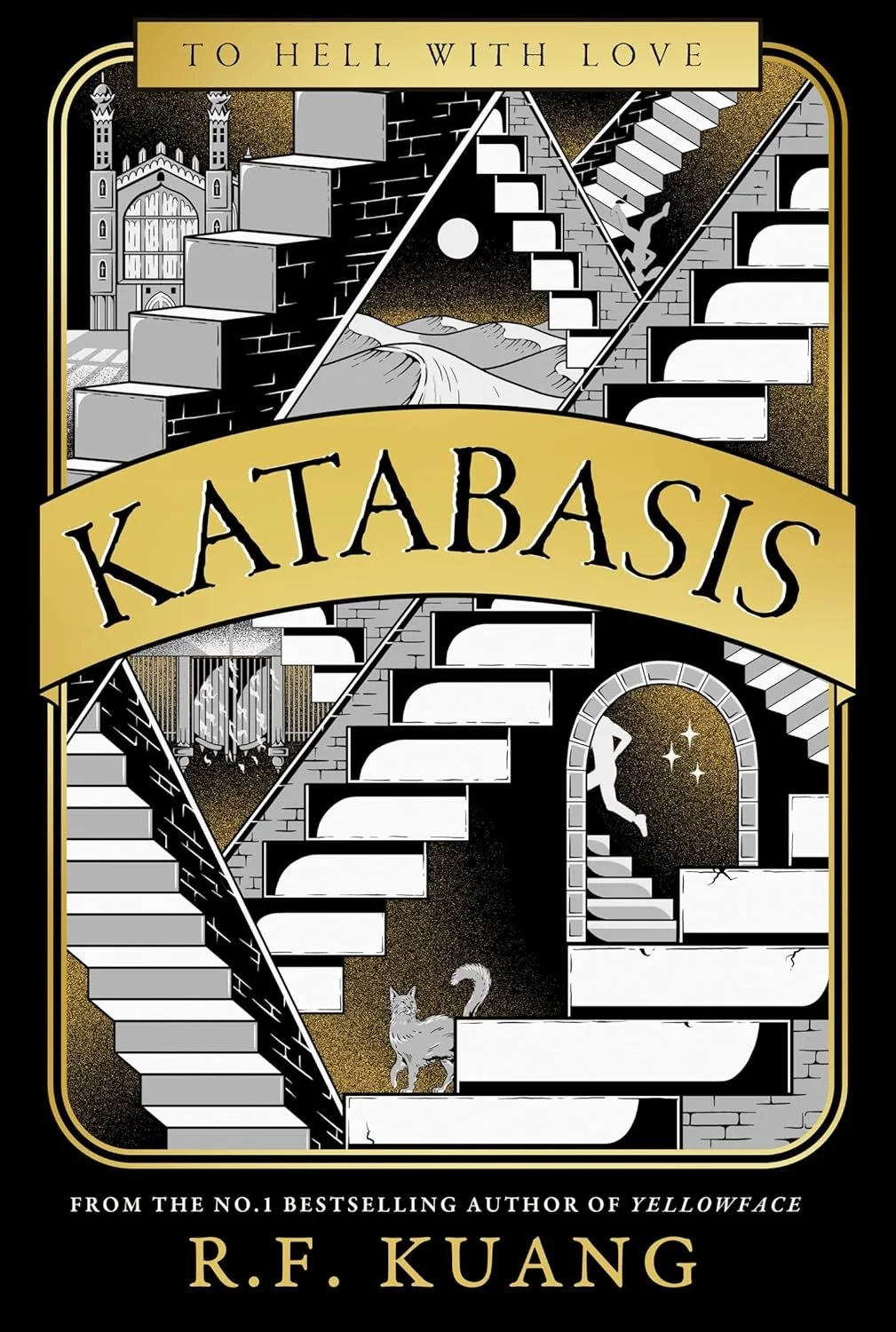
Katabasis by R.F. Kuang (2025). Published by HarperVoyager.
If you’re new here, and stumbled upon this blog through the mythical powers of the Internet, welcome! I know a lot of visitors to my website are people who randomly come upon this website through search engines like Google, but I also do have a lot of visitors who come back. Regardless: my name is Ashley, and I started this blog in order to keep track of everything I’m coming across in the world.
This blog post is interesting to me because lately, I’ve been struggling to get in my reading time. I was working for the longest time as a freelancer and contractor, but recently pivoted to an 8-5 job where I’m in an office. It’s not hybrid, so I’m always at home trying to put the puzzle pieces together of how I’ll get my reading done. I also continue working on this blog when I’m not at work, so the Instagram reels I’m fed about a 5-9 feel too real right now.
Anyways, I am trying to find that time to read here and there. Somehow I’m still on track for my Goodreads goal, even though I’ve been slowly giving up on the notion of reading goals in life. I think they can be a little too much pressure and takes the fun off of reading at the end of the day, and I want to read because I want to stay in touch with literature while also pursuing my side career as a writer.
If you’ve read my blog before, you may know already that I have a love-hate relationship with R.F. Kuang. I keep picking up her books despite this, which says something in itself, but usually when I read her books I get the sense that she’s such an extremely intelligent individual. Like she’s clearly someone who’s worked and lived within academia.
As someone who has also been in that world, but never been in the financial privilege to consider getting a PhD or ever attend an Ivy League, I get the indulgence. However, as a reader, I have some problems with her books that are particular to me, but I could see others agreeing (or disagreeing).
More on that later though, as this introduction is getting a little long. Let’s get into the review!
Two elite graduate students willingly dive into the depths of Hell to find their newly deceased advisor.
Alice Law can’t imagine failure, but one day, when she’s helping her advisor, the best magician in the world, everything she knows is about to turn upside down. Her advisor, Jacob Grimes, is killed while they’re doing the magical work they were expecting to go differently, leaving Alice, and several other students, without someone to supervise their work. The accident also may or may not be her fault. We won’t know that until later.
Alice can’t take failure though and decides the only way that she’s going to make her time at Cambridge worth it is if she goes into the literal depths of Hell, finds her advisor, and brings him back. It’s what people have talked about for decades, dreamed of during. Some may even call it a Great Quest—as we learn later in the novel.
Anyways, as she’s drawing the Pentagram and preparing to go into the depths of the Underworld, she’s joined by the Golden Boy Peter Murdoch. Peter has always been her rival at school, he can’t left her upstage his moment, and it seems he’s had the same exact thought of going into the Underworld to find Grimes.
He goes into the Underworld with her, kickstarting this not-so-epic adventure. From meeting the shades of undergraduate students past, who were killed because of Grimes, or one of his former darling graduate students, Elspeth (who has been erased from Grimes’ history for a plethora of reasons), their hunt for Grimes is about to unveil more than what Hell has to offer.
As a magical family starts hunting them down for their blood and what might be the only way out of Hell, Peter and Alice are going to have to learn how to survive when nothing seems to be going in their favor. And, as we learn throughout the course of the novel, Grimes himself was no saint.
There’s a bit of a god complex around how people see Grimes, which mirrors academia in real life. There are some pretty awful people who are in positions of power at universities, journals, and organizations, but because they are in those positions or have power people want to be around them. They ignore the ugly parts, or even make jokes about it after they’re in the system and have coveted positions themselves, which leads to systemic abuse across the board.
That’s something this novel digs deep into—and it tries to go into a lost. Trust me, I thought this novel was actually too short for what R.F. Kuang might have wanted to accomplish with it. I feel like there are a handful of important tangential plot lines that essentially get lost in the sauce.
The romance in this novel is one of the major plot lines, but for me it fell majorly flat. We’re not going to dive into spoiler territory here, but when I first saw some marketing for this novel I actually assumed that it was mainly going to be a romance set in Hell with a side of fantasy and adventure. This is a peak slow burn, and for what we get you might not be satisfied if you’re coming in for that aspect.
Overall Thoughts
I think I want to love an R.F. Kuang book, but as I reflect on them, I haven’t loved any. Katabasis falls into a similar boat, as it has the repetitive aspect of trying to hammer in themes, philosophy, and intellectualism in a way that doesn’t click. It feels like a performance in some ways, even when books like Babel and Yellowface grapple with very real and important issues.
Katabasis does too—Grimes isn’t the only advisor and academic out there that’s like this, which makes him a satirized villain of so many men in similar positions of power. I don’t deny this book that. It’s an important book in terms of its themes and how it has a message to get across. Sometimes I get the impression the book is built around XYZ event or concept and loses itself in how it tries to convey the author’s perspective and arguments.
Between the romance and the lull when the characters actually are in Hell, I just couldn’t get into it. I also didn’t care for either of the main characters, although I did understand and could empathize with Alice’s ambition to some degree. Peter doesn’t get interesting until a certain event happens.
The Kripkes were actually the most interesting characters, but they are the primary antagonists. Elspeth was also a character I was interested in, but we don’t get a ton of her either. Instead we’re stuck with the dynamic duo trying to figure out how to survive in the most human ways possible.
Go read it if you’re interested. Don’t let a bad review deter you, as taste is incredibly subjective. A book I might not love could be your favorite and vice versa. Neither of us are wrong!
Follow me below on Instagram, Goodreads, and Letterboxd for more.
![Jeju-do (제주도) is one of those places that reminds you of how stunning the world is
[7.12.2024 부터 7.14.2024 까지]](https://images.squarespace-cdn.com/content/v1/5ea1f794501b7153b29e7cd7/1721033601522-554E76HR01JUHDWZBJ1I/image-asset.jpeg)