Review of Mutiny: The Rise and Revolt of the College-Educated Working Class by Noam Scheiber
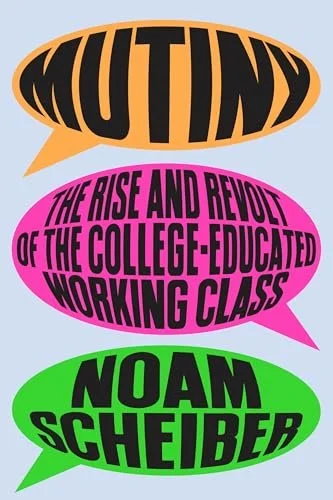
Mutiny: The Rise and Revolt of the College-Educated Working Class by Noam Scheiber (2026). Published by Farrar, Straus and Giroux.
If you’re new here, and stumbled upon this blog through the mythical powers of the Internet, welcome! I know a lot of visitors to my website are people who randomly come upon this website through search engines like Google, but I also do have a lot of visitors who come back. Regardless: my name is Ashley, and I started this blog in order to keep track of everything I’m coming across in the world.
This blog post is interesting to me because lately, I’ve been struggling to get in my reading time. I was working for the longest time as a freelancer and contractor, but recently pivoted to an 8-5 job where I’m in an office. It’s not hybrid, so I’m always at home trying to put the puzzle pieces together of how I’ll get my reading done. I also continue working on this blog when I’m not at work, so the Instagram reels I’m fed about a 5-9 feel too real right now.
Anyways, I am trying to find that time to read here and there. Somehow I’m still on track for my Goodreads goal, even though I’ve been slowly giving up on the notion of reading goals in life. I think they can be a little too much pressure and takes the fun off of reading at the end of the day, and I want to read because I want to stay in touch with literature while also pursuing my side career as a writer.
I don’t know where I first discovered this book, but wherever I first saw it, I know what drew me into it. At the time I was becoming more disillusioned with life and what was the reason for all of the education I had received, and then I saw this book and realized this was the right moment.
I ended up reading it on a Saturday night, when I wanted to read a nonfiction book instead of fiction. And then I realized this book wasn’t what I expected it to be!
Let’s get into the review.
Several case studies on highly educated people who, after college, worked mundane jobs and led union efforts at some of the biggest companies in the country.
So, if you were like me originally, you probably thought that this was going to be a book on recent history about college graduates not being able to find jobs and ultimately what may come out of that. Well, this is a different spin on that and not exactly a straightforward take.
Scheiber uses this book to document the stories of specific individuals who had quote-on-quote succeeded by getting a college degree. Then he Chaya Barrett, a graduate from Towson University who, while at school there, began working at the Apple Store. He writes about her story and how she helped the Towson Apple Store, formerly located in the Towson Mall, unionize.
They were the first Apple store to do so, and they definitely broke the mold. It was because of the rising cost of living and the lack of opportunities that lead young people like Chaya, who went to college and know what’s out there in the world, as well as what else they should have deserved.
Chaya is just one of a few stories documented in the book. We learn about the efforts from people similar to Chaya at Starbucks and Amazon, as well as the hostilities they faced when they tried to unionize. Then Scheiber broadens his scope and looks at Hollywood and their unions, which are actually considered a staple in order to keep the industry fair and equitable, including for actors.
All of this is to say that the title might be a little misleading, especially if you didn’t look at the synopsis and had no idea this was actually going to be about unions throughout its story. But that doesn’t make it less valuable: people who went to college and studied, for example, the humanities know what their options are, so when they’re forced to take jobs that are seen as lower class, they’re going to often try to make the most of it.
It felt bizarre to read this book because I grew up going to the Towson Mall, knew the Apple Store in there, went to high school down the street, then came back to Towson for graduate school. When I finally started reading this book, Apple had announced they were shutting down this store, which is always incredibly crowded. It was definitely because of the union, as store members were not allowed to transfer anywhere else (or so I heard).
Overall Thoughts
Although this book wasn’t what I expected originally, it was well-written. I wrote above about the shock I had when I picked this book up and realized a core part of it was an Apple store I grew up going to and knew, and it added context to its closure. I think Scheiber has a compelling story here, and I could see parts of myself in the young people he was describing.
That said, this is something that I think others should read regardless if they’re researching unions or not. The circumstances young people are facing are what forced these individuals to try and seek out alternatives. Whether you think they’re justified or not in that approach is irrelevant—the truth of the matter is that the system failed them, so when they try to change it, they’re demonized for that fact.
I think this is definitely worth picking up once if it interests you. I had a good time with this book overall, although I don’t know if I’ll return to it in the near future.
Follow me below on Instagram, Goodreads, and Letterboxd for more.

![Jeju-do (제주도) is one of those places that reminds you of how stunning the world is
[7.12.2024 부터 7.14.2024 까지]](https://images.squarespace-cdn.com/content/v1/5ea1f794501b7153b29e7cd7/1721033601522-554E76HR01JUHDWZBJ1I/image-asset.jpeg)