Once There was a Town: The Memory Books of the Lost Jewish World by Jane Ziegelman
Review of Once There was a Town: The Memory Books of the Lost Jewish World by Jane Ziegelman
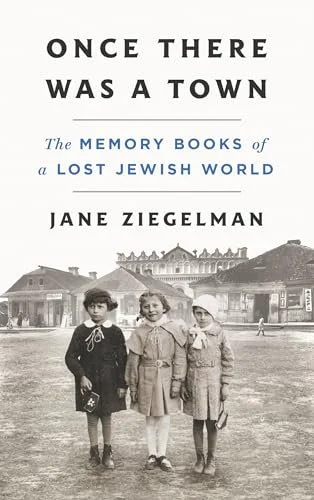
Once There Was a Town: The Memory Books of a Lost Jewish World by Jane Ziegelman (2025). Published by St. Martin’s Press.
If you’re new here, and stumbled upon this blog through the mythical powers of the Internet, welcome! I know a lot of visitors to my website are people who randomly come upon this website through search engines like Google, but I also do have a lot of visitors who come back. Regardless: my name is Ashley, and I started this blog in order to keep track of everything I’m coming across in the world.
This blog post is interesting to me because lately, I’ve been struggling to get in my reading time. I was working for the longest time as a freelancer and contractor, but recently pivoted to an 8-5 job where I’m in an office. It’s not hybrid, so I’m always at home trying to put the puzzle pieces together of how I’ll get my reading done. I also continue working on this blog when I’m not at work, so the Instagram reels I’m fed about a 5-9 feel too real right now.
Anyways, I am trying to find that time to read here and there. Somehow I’m still on track for my Goodreads goal, even though I’ve been slowly giving up on the notion of reading goals in life. I think they can be a little too much pressure and takes the fun off of reading at the end of the day, and I want to read because I want to stay in touch with literature while also pursuing my side career as a writer.
A lot of the books I am picking up these days are ones that I find myself thinking that I’ll be passionate about in the moment. I find that if reading is a chore in the sense where the book is difficult to get through, then I’ll have a lot more trouble getting through them. I don’t know where I first saw Once There Was a Town, but the synopsis of its history really interested me, so I picked it up.
Let’s get into the review! I don’t want to ramble too much in the introduction, as I know these can get quite long.
The story of one predominantly Jewish town, Luboml, and Yizkor Books that preserved Jewish heritage and traditions—even beyond the Holocaust.
The premise and idea for this book came from something simple in Ziegelman’s life. She knew she was Jewish and that her grandparents came from a Polish town called Luboml, but she never knew about Yizkor Books, which are memory books for Jewish communities from certain areas. They’re kind of a collaborative work between the Jews in that community to fill in the blanks, especially after the Holocaust.
Ziegelman finds out about the memory book and that opens up the rabbit hole of what happened to Luboml’s Jewish community. Her grandparents and family members never really spoke about what happened to their friends and family that were there, as they managed to get out in the time prior to the Soviets and Germans taking over Poland, but that forms the crux of this story.
Luboml was a town where the gentiles and Jews lived side by side. As Ziegelman describes it, the Jews and gentiles would even switch off the market times and trade with each other, making it a relatively harmonious lifestyle for both communities.
However, with the arrival of World War II, that became the beginning of the end. The Jews of Luboml thought they were safe when Poland was divided between the Soviets and the Germans, but, as we come to learn, there are some horrors coming for them.
This was a small town and thriving community, and Ziegelman’s connection to what went on in Luboml is an interesting take for a book. It’s something that feels so minuscule in the grand scheme of history, but it’s when we lose the smaller moments and town’s histories that’s how we forget how these horrors and atrocities began to spiral out of control.
Once There Was a Town is a succinct book, but it’s fairly concise in its history while also being very accessible. I knew nothing of this town or broader Polish history, and I felt like this was a great primer for digging deeper.
Overall Thoughts
I read this book over the course of two nights and thought that it was such an excellent read. In the previous paragraph and section, I wrote about how succinct it was, but I thought this was definitely a lot of information condensed in a way that was highly effective. It doesn’t feel like we’re reading dense (and really sad) history in a way where we’re overloaded.
I think I want to read more nonfiction like this in the near future, if it exists. Something that’s always interested me as a reader and an academic are the stories that don’t often get told, so this is the kind of literature that needs to be published more just so I can read!
Pick it up if you get the chance—I think this is worth a shot if it’s something that might be of interest to you.
Follow me below on Instagram, Goodreads, and Letterboxd for more.
![Jeju-do (제주도) is one of those places that reminds you of how stunning the world is
[7.12.2024 부터 7.14.2024 까지]](https://images.squarespace-cdn.com/content/v1/5ea1f794501b7153b29e7cd7/1721033601522-554E76HR01JUHDWZBJ1I/image-asset.jpeg)