So Long, See You Tomorrow by William Maxwell
Review of So Long, See You Tomorrow by William Maxwell
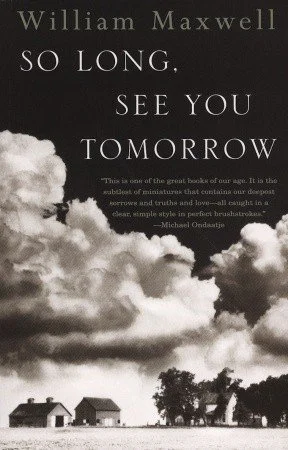
So Long, See You Tomorrow by William Maxwell (1996). Published by Vintage.
If you’re new here, and stumbled upon this blog through the mythical powers of the Internet, welcome! I know a lot of visitors to my website are people who randomly come upon this website through search engines like Google, but I also do have a lot of visitors who come back. Regardless: my name is Ashley, and I started this blog in order to keep track of everything I’m coming across in the world.
This blog post is interesting to me because lately, I’ve been struggling to get in my reading time. I was working for the longest time as a freelancer and contractor, but recently pivoted to an 8-5 job where I’m in an office. It’s not hybrid, so I’m always at home trying to put the puzzle pieces together of how I’ll get my reading done. I also continue working on this blog when I’m not at work, so the Instagram reels I’m fed about a 5-9 feel too real right now.
Anyways, I am trying to find that time to read here and there. Somehow I’m still on track for my Goodreads goal, even though I’ve been slowly giving up on the notion of reading goals in life. I think they can be a little too much pressure and takes the fun off of reading at the end of the day, and I want to read because I want to stay in touch with literature while also pursuing my side career as a writer.
Sometimes finding the right book means I just wander through my library until I find it. And on this day, in the middle of the fiction section, I found a copy of So Long, See You Tomorrow. I had never heard of this book before, which is interesting considering I would describe this as a contemporary classic (in the sense that it was published in the contemporary era), but I had not encountered it before.
This is a very short read, clocking in at a little over one hundred pages, so one night I drew up a bath and decided to read this all the way through in there. I finished it in about an hour, which makes sense for a book of this length.
Let’s get into the review! Lots to discuss here.
In 1920s Illinois, a man is murdered on a farm, leading to events that haunt the narrator for the rest of his life.
This review probably isn’t going to be the longest, as this novel is fairly straightforward. The narrator is reflecting on an event that happened in his childhood fifty years prior to the present day, when Illinois was in the 1920s and life was a lot different.
We learn a little bit about him before we got into the deep dive of what he thinks happened on that fateful day. His mother died fairly young, leaving behind his father and several children, and while his father remarries, the narrator has that scar of his mother dying suddenly of the influenza. There were a lot of moving parts in his life after his stepmother came in, especially when they built a new house from scratch.
As he describes his school and home life, we slowly peel back the bandage of what happened on a fateful night: a farmer was shot on his farm by someone else. The motive? The shooter’s wife ended up taking him to court for divorce and he decided to take revenge on the guy who he blamed for his misfortune.
Now, there’s some handholding on the narrator’s part on how we got to this point, which makes up the question of how reliable of a narrator is he. He mentions about how he goes through the old newspapers and asks around about how exactly these events unfolded, but there’s still fifty years of distance and memory to wade through. The shooter also killed himself after the killing, leaving behind a crucial piece of testimony.
Despite that, the focus is largely on the shooter’s son, who, when the narrator was in school, was actually his friend. He calls him Cletus, but at one point in the novel he describes how that actually wasn’t his name, which adds to the element of being an unreliable narrator. But for Cletus, what happened between his mother and father would upend his life.
The narrator is very much haunted by the last time he saw Cletus, as they looked at each other and pretended they never knew each other in the way they did. Then he goes into detail about how he imagined Cletus’ life to be, which is very much filling in the gaps of what he doesn’t know to try and justify the story in his end, making sense of what happened all those years ago.
Overall Thoughts
For such a short novel, this was an interesting character study throughout. And not because of Cletus: I was more interested in how the narrator was inserting himself and his biases into these events he constructed in his head. Some of it is definitely real, but other elements are an older man trying to grapple with what’s happened.
This felt like reading something that was a narrative of a distant past, and now, as a modern reader, this was Illinois from a hundred years ago. While the scandal is the focal point of this novel, I was actually more interested in the descriptions of life in Illinois during this time and how they came to interact with each other. Maybe that’s the historian in me really just wanting to understand and contextualize what’s happened here.
I think if you’re interested in this novel, pick up a copy at your local library or indie bookstore. It’s something that I would say is worth reading at least once.
Follow me below on Instagram, Goodreads, and Letterboxd for more.
![Jeju-do (제주도) is one of those places that reminds you of how stunning the world is
[7.12.2024 부터 7.14.2024 까지]](https://images.squarespace-cdn.com/content/v1/5ea1f794501b7153b29e7cd7/1721033601522-554E76HR01JUHDWZBJ1I/image-asset.jpeg)