A Least We Can Apologize by Lee Ki-ho
Review of At Least We Can Apologize by Lee Ki-ho
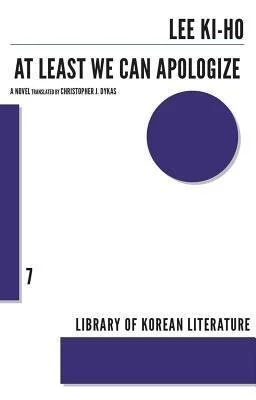
At Least We Can Apologize by Lee Ki-ho, translated by Christopher J. Dykas (2013). Published by Dalkey Archive Press.
If you’re new here, and stumbled upon this blog through the mythical powers of the Internet, welcome! I know a lot of visitors to my website are people who randomly come upon this website through search engines like Google, but I also do have a lot of visitors who come back. Regardless: my name is Ashley, and I started this blog in order to keep track of everything I’m coming across in the world.
This blog post is interesting to me because lately, I’ve been struggling to get in my reading time. I was working for the longest time as a freelancer and contractor, but recently pivoted to an 8-5 job where I’m in an office. It’s not hybrid, so I’m always at home trying to put the puzzle pieces together of how I’ll get my reading done. I also continue working on this blog when I’m not at work, so the Instagram reels I’m fed about a 5-9 feel too real right now.
Anyways, I am trying to find that time to read here and there. Somehow I’m still on track for my Goodreads goal, even though I’ve been slowly giving up on the notion of reading goals in life. I think they can be a little too much pressure and takes the fun off of reading at the end of the day, and I want to read because I want to stay in touch with literature while also pursuing my side career as a writer.
One of my many goals I embarked upon a few years ago is that I wanted to read through most of the Library of Korean Literature. Back then I was in graduate school and not yet completely dead inside, as well as ambitious, so I thought I could do it in a year or two. I was very wrong about that fact, especially considering I was writing my master’s thesis on Korean women’s literature.
I didn’t get burned out on Korean lit as a whole, but I did have to shift my priorities. I’m picking that goal back up again though lately in order to prevent myself from going insane at the fact I could really just dedicate my entire life to work, which seems fairly depressing to me. I can’t do that.
I picked up At Least We Can Apologize in order to continue on that quest of reading all of the Korean Literature books. I don’t think I’ll finish in this decade, but I’m going to try!
Let’s get into my review of the book.
Two men work for a company that specializes in apologies, no matter how brutal or sad they can be.
This is a novel that leans on the bizarre aspects of its premise, but it certainly offers quite a bit of philosophical based questions in the end. Its narrator is a man is at an institution, and it’s there he meets his fellow resident Si-bong. We learn fairly quickly through his experiences that this is no normal place, as it seems they’re beaten and drugged every single day.
Not for the faint of heart if you can’t handle those kinds of discussions, but in the world of the novel, Si-bong and our narrator kind of trauma bond over their experiences in there together. It’s at the institution where they start learning a specific art though: the one where they can apologize for other people so they don’t have to.
Specifically, in this place, they start apologizing for the other people in there with them. So when the time comes for them to get out of the institution (I couldn’t tell if they left on voluntary terms or if they straight up escaped, so feel free to ping me if you were able to piece that aspect together), they start a business where they apologize for people.
Some apologies in life are mundane and people just can’t own up to them. But as we see later on in the novel, people are willing to do the most outlandish things in order to escape accountability, and many of the cases that these two are brought on to apologize for are not simple ones. It’s both incredible and awful what they’re apologizing for sometimes and it can resort in violence on their end.
In many ways I saw this book as a reflection of Korean society. As I type this sentence and mull on it over, I looked up the date this was released in Korean. It was 2009, which is interesting to me because I could see this kind of novel coming out in 1990s Korea, or even in the late eighties. It feels like a specific time and place to me, although many of the sentiments echoed throughout this book are still pervasive in modern Korean society.
There’s also a definite class element to everything going on. From our narrator and his buddy he goes into business with to the clients they pick up as they apologize, some of it screams class exploitation (from the institute) as well as showing how lower incomes are basically competing with each other at times in order to get by in their day to day lives. When people feel threatened, they’re pushed to do things that can come across as pretty insane.
Overall Thoughts
I think this was a little surrealist novel that I could get with, but it wasn’t my favorite. I don’t know if it was the translation style or the writing itself, but I found it to be a little difficult to get through in that sense. I did finish the novel—or we would not be reading this review right now—but I kept stopping to take breaks. That’s not good for me as a reader because sometimes I never jump back into it.
Regardless, I am glad I read this book. I think it echoes a lot of themes we see throughout Korean literature, and it shows something very deep about Korean society and culture. I have read a lot about shame culture in Korea, and although I’ve lived there twice I have not really had the chance to experience that firsthand. I do know a lot about it.
This is an interesting book to situate in those discussions for sure. I think if you’re interested in that, or class problems in Korea, this might be a good book to pick up next! Or if you’re interested in Korean literature as a whole. Go find a copy and read it whenever you get the chance.
Follow me below on Instagram, Goodreads, and Letterboxd for more.
![Jeju-do (제주도) is one of those places that reminds you of how stunning the world is
[7.12.2024 부터 7.14.2024 까지]](https://images.squarespace-cdn.com/content/v1/5ea1f794501b7153b29e7cd7/1721033601522-554E76HR01JUHDWZBJ1I/image-asset.jpeg)