At Dusk by Hwang Sok-young
Review of At Dusk by Hwang Sok-young
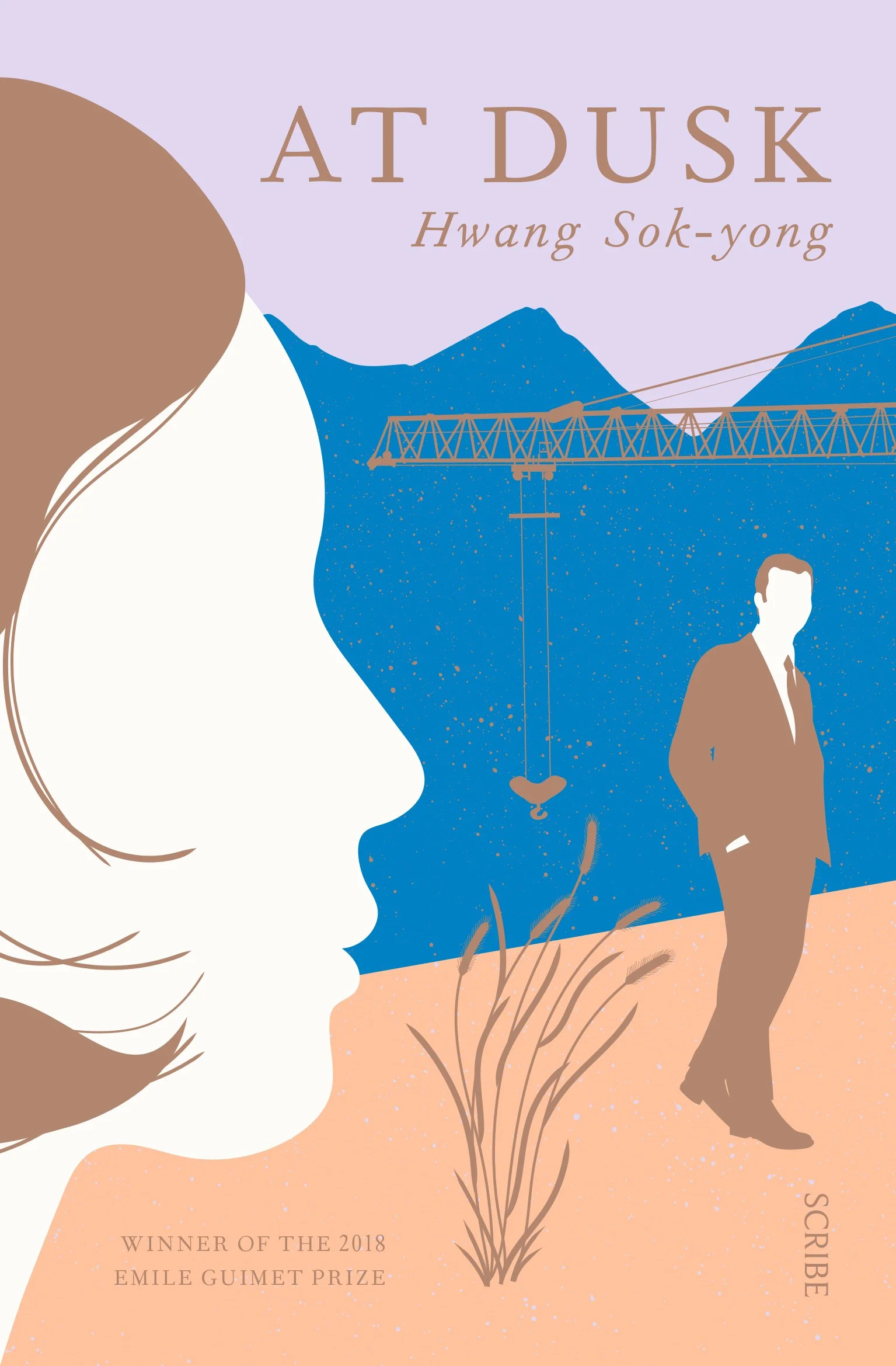
Review of At Dusk by Hwang Sok-young (2018). Published by Scribe Publications.
If you’re new here, and stumbled upon this blog through the mythical powers of the Internet, welcome! I know a lot of visitors to my website are people who randomly come upon this website through search engines like Google, but I also do have a lot of visitors who come back. Regardless: my name is Ashley, and I started this blog in order to keep track of everything I’m coming across in the world.
This blog post is interesting to me because lately, I’ve been struggling to get in my reading time. I was working for the longest time as a freelancer and contractor, but recently pivoted to an 8-5 job where I’m in an office. It’s not hybrid, so I’m always at home trying to put the puzzle pieces together of how I’ll get my reading done. I also continue working on this blog when I’m not at work, so the Instagram reels I’m fed about a 5-9 feel too real right now.
Anyways, I am trying to find that time to read here and there. Somehow I’m still on track for my Goodreads goal, even though I’ve been slowly giving up on the notion of reading goals in life. I think they can be a little too much pressure and takes the fun off of reading at the end of the day, and I want to read because I want to stay in touch with literature while also pursuing my side career as a writer.
Although I’ve been spending a lot of time with my blog trying to diversify the kinds of books and movies I’m picking up lately, Korean literature is something that I fall back on when times seem a little difficult. I did my master’s thesis on Korean colonial women writers and what they were expressing during their literary careers, and I studied abroad and lived in Korea twice, so it happens to be an area I know where too much about.
At Dusk is a book I’ve been meaning to read for a while now, so when I had a free slot one afternoon I decided to sit down with it and read it in one go. That proved to be quite the right move, as I ended up finishing the book in one sitting.
Let’s get into the review! I don’t want to keep rambling in the introduction, as I know it’s often what people aren’t here for.
The story of a man in contemporary Korea who made it in life, and an artistic woman whose story ties into his.
There are two slightly connected stories throughout this novel, but I’m going to focus on the main one first. Its protagonist is Park Min-woo, who grew up in poverty when South Korea wasn’t yet the superpower it is today. He did everything “right”—or as right as someone who was in a developing society could be.
He went to the most prestigious university in the country—Seoul National University, I presume, from the context clue there—despite coming from the wrong circumstances (aka: being born in poverty and not with a golden spoon in his mouth) to be there. Now, in the present day, he’s the head of a large architectural firm.
As his company starts being investigated for corruption, it situates him and Korea’s situation overall with its broader history. He was growing up and studying when Korea was rapidly modernizing and becoming one of the Asian Tigers, which lends to his luck and success.
Things get even more murky on his end though when a letter arrives from his former love as a child: Cha Soona. While he was able to escape the circumstances of his life that they shared together, she was never able to move on and find the same amount of success as him. That’s why I mention luck—although gender definitely plays a role here too—as not everyone is able to move up in society like he did.
Anyways, a chunk of his narrative is spent reflecting on his life and country, situating him in a unique set of circumstances that not everyone can say they’ve lived through. This ties into the second story, where we see the perspective of a young female playwright.
Her name is Jung Woo-hee, and she’s in her late twenties. She doesn’t exactly make a good income like Min-woo because of her artistic inclinations. I see her as a foil to him in the sense where we see how she lives like he did as a child. Seoul isn’t all high rises and people making good money.
Instead she’s hustling to make her art, even if she’s kind of failing at finding that kind of work, and spends her evenings at the night shift at a convenience store chain. She really shows us how despite Korea coming so far, not everyone is able to take advantage of the opportunities—if they can at all even.
Overall Thoughts
I really liked the premise of this novel, but thought it fell a bit flat in terms of execution in the end. I liked Min-woo’s narrative in the sense where it shows genuine regret and reflection, but the story with the playwright kind of just feels like it’s thrown in there. Perhaps splitting the novel more evenly and extending its length would’ve aided in my feelings here.
The writing and translation itself is great though. I like Kim-Russell’s translations a lot, and when I was in college I attended a talk with her at the Asian American Writers’ Workshop. Back then Korean literature wasn’t that big, so I remember being in awe that she was doing this kind of work. How far we’ve come since then!
Anyways: I enjoyed this novel, but I don’t know if I would return to it. I think that if it interests you then definitely give it a chance; this is a book that really might be compelling, or you may want to put it down about halfway through. Give it a chance though!
Follow me below on Instagram, Goodreads, and Letterboxd for more.
![Jeju-do (제주도) is one of those places that reminds you of how stunning the world is
[7.12.2024 부터 7.14.2024 까지]](https://images.squarespace-cdn.com/content/v1/5ea1f794501b7153b29e7cd7/1721033601522-554E76HR01JUHDWZBJ1I/image-asset.jpeg)