Sad Tiger by Neige Sinno
Review of Sad Tiger by Neige Sinno
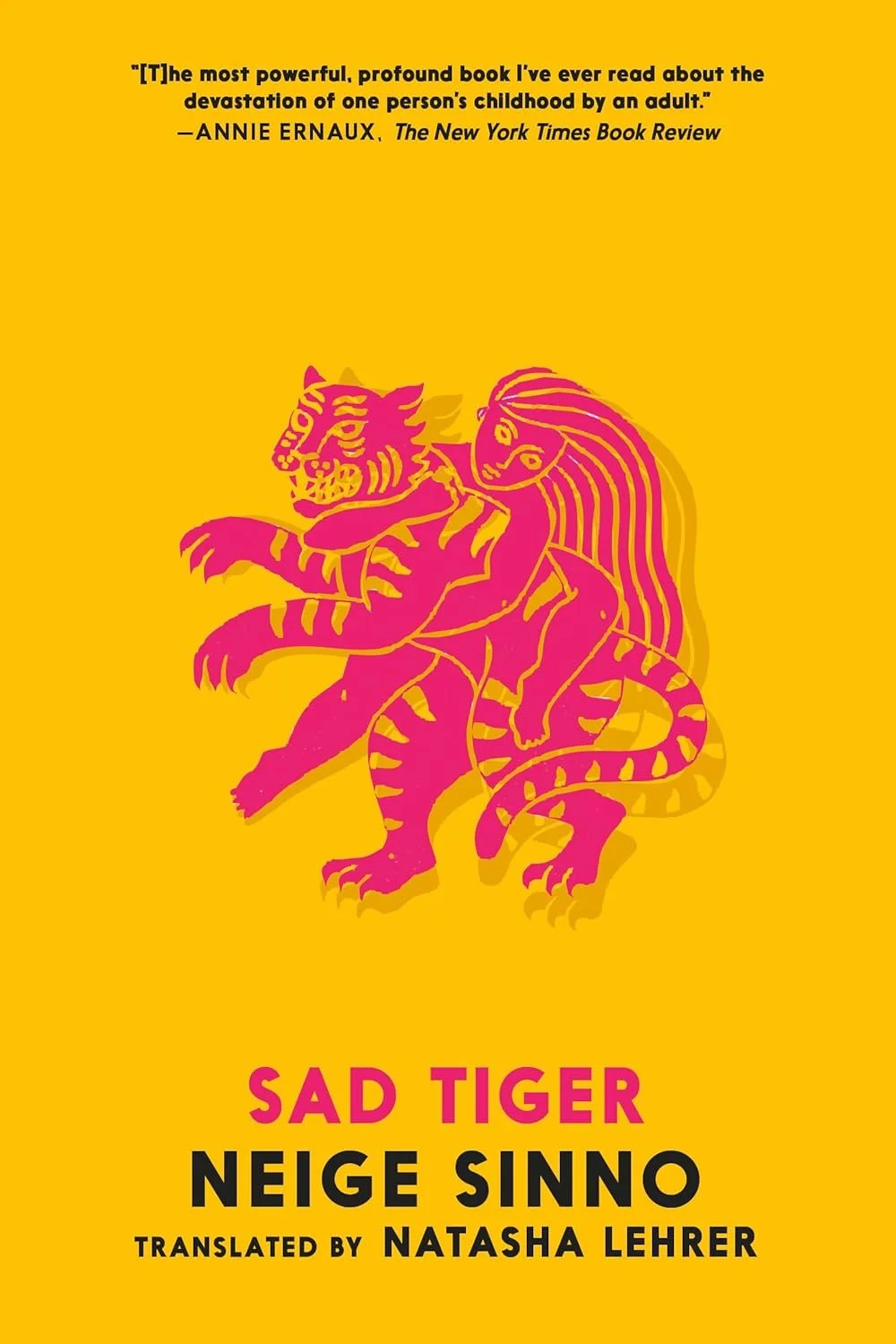
Sad Tiger by Neige Sinno, translated by Natasha Lehrer (2025). Published by Seven Stories Press.
If you’re new here, and stumbled upon this blog through the mythical powers of the Internet, welcome! I know a lot of visitors to my website are people who randomly come upon this website through search engines like Google, but I also do have a lot of visitors who come back. Regardless: my name is Ashley, and I started this blog in order to keep track of everything I’m coming across in the world.
A lot of my blog posts for the past year or so have been starting with discussing the state of my employment, as I one of the many people looking for a full-time job when it seemed impossible to find one. This blog post (although it’s coming out months later from when I’m typing this due to the sheer nature of my publishing schedule) is one of the last blog posts to come out of the period where I was lazing about and doing content creation/freelancing full time.
It was a fruitful time, but I was just ready to work a corporate job and see what that was like. In the days leading up to when I was starting my job, I was reading, writing, and consuming as much as possible because I had this fear that I was going to not have time once I was starting this 8-5 job.
This book review comes from a book I picked up in the depths of my library because I thought the title and cover were interesting. I had heard of the press this book came out of, so when I saw that as well, I knew I wanted to try reading the synopsis on this book jacket. And I will admit: at first I thought this was an Asian book because of the tiger and was pleasantly surprised to see I had picked up a French book.
I’ve been wanting to read more French books, that’s for sure. My theme for most of 2025 is trying to diversify the books I read and perspectives. I know I read a lot of Korean and Japanese literature, as well as broader Asian-American literature, and I want to try reading different traditions. Latin America and Africa have been focuses lately, as well as more Eastern European and Slavic novels.
Anyways: I read this while on the New York City subway right before I started my new job. I finished it on the subway, which felt fitting, although there were moments when I wanted to cry in public because of what I was reading.
Let’s get into the review!
The story of the author reflecting on sexual abuse by her stepfather and how it dismantled life as she knew it.
I think from the heading above that if you have any triggers towards sexual abuse and rape, then this book might be something you approach cautiously. Sinno is unafraid to dissect what exactly happened to her at the hands of her stepfather, and I could see someone really being triggered if they haven’t healed enough reading some of what Sinno wrote.
That said, this is a novel that has a very compelling writing form. Sinno tends to write in these fragments, which I found to be fitting considering her life can be seen as fragmented after what happened to her. Drawing on other literary and art sources, Sinno discusses how, as a child, her stepfather began abusing her when she was only about eight years old (or seven—the number seems a bit unclear to me).
She methodically describes what exactly he would do to her, then discusses how she considers her life to have been stolen away by this man who took away her choice. At one point, she even considers her stepfather’s actions to be something that took away her life for some time, which is something she reclaimed later in life.
The author was fourteen when he finally stopped with the abuse, but we see how the topic of what happened to her remained undiscussed in the family, even when it was abundantly clear what was going on in the household. Her stepfather held power in so many different ways, and this culture of silence and shame perpetuated what happened to her even further.
Sinno does end up taking her stepfather to court and discusses that in this book as well, which is something I thought was very powerful to read about. He ended up in prison, but her act of bravery and pursuit of justice is admirable. Her even writing this book, digging deep into her own trauma, is also very admirable.
It’s also very racial in how she’s using criticism and the memoir form to openly discuss incest and child abuse. I don’t think I’ve ever read a book quite like this in my life, which says something in itself—I’ve read over a thousand books alone from when I started documenting them on my Goodreads in 2017, and I would consider myself fairly well-read. No book I can recall was like this.
Overall Thoughts
It feels weird to say and type that I enjoyed a novel like this, but I really did. Its defiance of genre is something I want to emulate in my own writing, and one day I wish to be as brave as this author has been. Her fusion of literary analysis, criticism, and the nonfiction form is to be emulated in future writing, even though other writers should make it their own instead of simply copying it.
I specifically mention genre again because as a writer and reader myself, as well as someone who really dug deep into these concepts in graduate school as an academic, I believe that hybrid work is a way of unveiling the self in a way straightforward genres and literature cannot do.
So by bringing in these other elements, Sinno has opened up completely new worlds and opportunities for us as a reader to understand the landscape of her mind. We don’t think exclusively in language. We reference art and literature, songs, have visual images in our heads. When we use that in our own writing, we come closer to understanding each other on a personal level.
All of this is to say that this is very well written, and that if you can handle it and are interested, then definitely read it! I think it’s worth picking up at least once.
Follow me below on Instagram, Goodreads, and Letterboxd for more.
![Jeju-do (제주도) is one of those places that reminds you of how stunning the world is
[7.12.2024 부터 7.14.2024 까지]](https://images.squarespace-cdn.com/content/v1/5ea1f794501b7153b29e7cd7/1721033601522-554E76HR01JUHDWZBJ1I/image-asset.jpeg)