We Computers by Hamid Ismailov
Review of We Computers by Hamid Ismailov
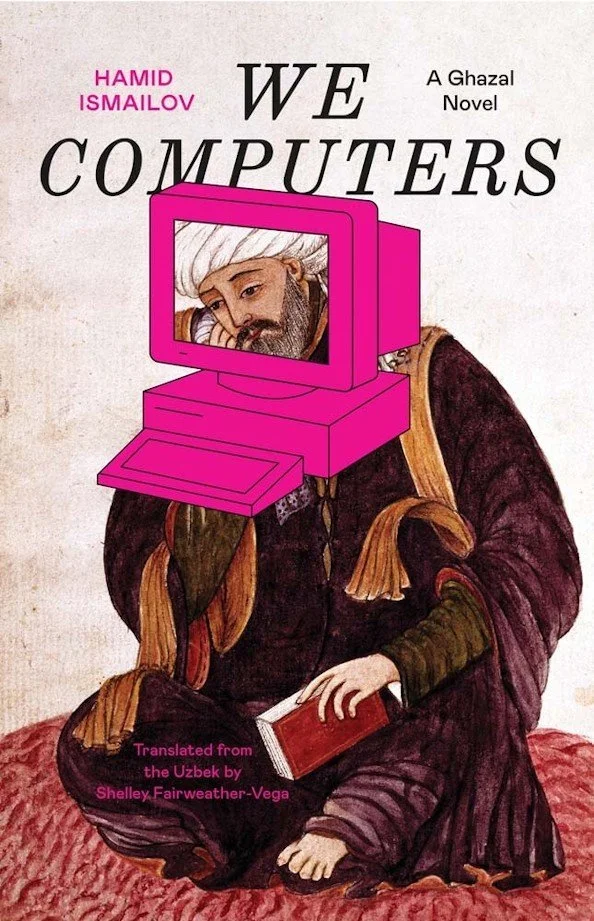
We Computers by Hamid Ismailov, translated by Shelley Fairweather-Vega (2025). Published by Yale University Press.
If you’re new here, and stumbled upon this blog through the mythical powers of the Internet, welcome! I know a lot of visitors to my website are people who randomly come upon this website through search engines like Google, but I also do have a lot of visitors who come back. Regardless: my name is Ashley, and I started this blog in order to keep track of everything I’m coming across in the world.
This blog post is interesting to me because lately, I’ve been struggling to get in my reading time. I was working for the longest time as a freelancer and contractor, but recently pivoted to an 8-5 job where I’m in an office. It’s not hybrid, so I’m always at home trying to put the puzzle pieces together of how I’ll get my reading done. I also continue working on this blog when I’m not at work, so the Instagram reels I’m fed about a 5-9 feel too real right now.
Anyways, I am trying to find that time to read here and there. Somehow I’m still on track for my Goodreads goal, even though I’ve been slowly giving up on the notion of reading goals in life. I think they can be a little too much pressure and takes the fun off of reading at the end of the day, and I want to read because I want to stay in touch with literature while also pursuing my side career as a writer.
I’ve been meaning to read We Computers ever since it came out a bit ago. This blog post is scheduled ahead of when I read this, which was during a flight to Florida from Baltimore-Washington International Airport. I read two books en route to Florida, as we had a bit of a layover in Charlotte.
Anyways, this was a bit tough for me to get through, but I really wanted to persevere and finish this one. Let’s get into the review!
A man in France becomes obsessed with algorithms and ghazals, leading to studies in Persian and Central Asian literature.
This is a novel that runs on algorithms and patterns, which is something you’ll see when you pick it up yourself. Its protagonist is Jon-Perse, a man in France who is both a poet and a psychologist. It’s through his Uzbek translation partner he becomes exposed to Persian poetry for the first time.
Once could call it love at first sight, as Jon-Perse hasn’t experienced such beautiful lyrics reflecting the beauty of life before. As he acquires a computer for the first time, then a new invention at the time we learn his story, he wants to use it for understanding this poetry he’s encountering for the first time.
With his computer he starts building a program that can not only analyze the poems and literature he feeds into it, but also generate new ones based on the work that it has analyzed in the past. It’s the modern day reflection of AI, and we even see his literary translator referred to his initials (AI), which leads to broader questions, as we have a French man trying to recreate poems not from his own culture.
This is all mixed in with other poetic phrases and translations from the period the classic Persian poets worked within, as well as a juxtaposition of dreams and the life of Hafez, one of the most prominent writers from Persian literature.
I’d call this a book that really mixes in the modern world with the concepts introduced by technology. I think in the 2020s, when this is published and I’m reading it, we see AI as something that can be both a boon and a bane.
Not only can it replicate literature, it’s through a computer we start to lose a bit of ourselves. At the same time though I can see the human element that this shows, as well as the thread from the past. In the end, aren’t most books and forms of literature based on an algorithm? So what draws the line here?
I don’t have an answer for that question, but it was what I was thinking upon finishing this one!
Overall Thoughts
All in all, I thought this was a really thought provoking novel. If you’re someone who doesn’t have an interest though in these modes of literature then you might find this really dense—or you might come out of this with a newfound interest.
It was really interest for me as well to read a book from the Uzbek in translation. I’ve read shorter pieces on Words Without Borders before translated from the Uzbek, but this is the first time I’ve acquired a full-on novel in translation.
If this interests you then you should pick it up for sure. If not maybe ease your way into it, as I’m pretty experienced with this kind of work and still found it hard to find my footing. But once I did, I though that this was a fun ride.
Follow me below on Instagram, Goodreads, and Letterboxd for more.